the HARVEST – April 2026
Interview with Ross Lovegrove, Part 2
Headline: Beyond the Seed: Ross Lovegrove on AI, Authorship and the Evolution of Design
Standfirst: In the second instalment of our conversation, Ross Lovegrove explores co-creation with AI, the limits of machine intelligence, and why the future of design depends on principles closer to nature than code alone.
If the first part of our conversation with Ross Lovegrove established the philosophical architecture of his thinking—his insistence that design must be coded with an inner DNA of Design, Nature and Art—then this second part moves decisively into more complex terrain.
Few designers of his generation occupy such a rarefied position: his work sits simultaneously in the permanent collections of major museums, within the pipelines of advanced manufacturing, and at the frontier of conversations around artificial intelligence, computational engineering and the future of form. To speak with Lovegrove is to encounter a practitioner who has long operated ahead of the curve.
What emerges is not simply a commentary on AI as a tool, but a deeper interrogation of authorship, intelligence and evolution itself. Lovegrove’s collaboration with Google DeepMind—training models on decades of his own drawings, selecting a single “seed” from hundreds of generated variants—becomes a lens through which to examine the shifting boundary between human instinct and machine amplification.
We cover morphogenesis and quantum systems, the slow cognition of drawing and the accelerated sequencing of algorithms, revealing a designer less concerned with novelty than with the conditions under which something genuinely new can emerge.
Lovegrove’s position is both challenging and clarifying. He resists the flattening effects of infinite iteration, argues for natural selection within generative processes, and insists that intelligence, whether human or artificial, must ultimately be anchored in purpose, performance, and meaning.
In your recent work with Google DeepMind, AI was trained on your own sketches and design language to generate new chair concepts. What did that process reveal to you about the difference between a designer’s style and a designer’s underlying intelligence?
I prefer the word “language” to “style.” In my case, I naturally harness core principles that have kept me on a path that is true to myself.
In this sense, I design more like an artist… or what I feel comfortable calling myself is a “Sculptor of Technology.”
The underlying intelligence in the conception and manufacturing of globally positioned objects, like a smartphone, for example, cannot exist without the intelligence that drives their creation.
You have described AI as if it were “thousands of oneself” amplifying your DNA. At what point does that amplification become genuine co-authorship, and at what point does it risk flattening the singularity that made your work distinctive in the first place?
This is a very thought-provoking question. My creative process has always functioned like an algorithm, even before the term existed. AI large language models, built on one’s own complex library of sources, will undoubtedly generate infinite new typologies or variants.
At this stage in my career, I find it fascinating that such tools exist… opening up a wealth of new “species” that time and circumstance never allowed me to create as a singular human mind. However, running such sequences at speed suggests a saturation of the self: ideas, concepts, and mutations come and go rapidly. Not flatlining, but becoming repetitive, potentially leading to burnout.
To achieve evolutionary longevity, these ideas must incorporate principles of natural selection grounded in the laws of nature. By definition, during the slow and considerate act of drawing, one is already creating in a state of morphogenesis so that what is drawn is in a natural neurological flow of conscious and subconscious thought.
That intention or objective can change at any moment, but it remains one’s own instinctive choice. Slow consideration is the key to reaching an artistic goal—even if the outcome differs significantly from the original intention.
My recent project with Google DeepMind, upon reflection, seemed to be a historical pivot point… even in selecting me to undertake such a self-referential project where the unique human skill of drawing is the core generator of content.
You have long argued that design should behave like a living system, guided by nature rather than styling. Does generative AI, in your view, move design closer to biological intelligence, or does it still need a human hand to avoid becoming merely a highly sophisticated mimicry machine?
I’ve long advocated that design should be coded with invested inputs of irrefutable performance characteristics.
My friends at LEAP 71 are creating rocket engines of astonishing beauty because they are coding a high-performance dialogue between function, purpose, material, and advanced manufacturing technologies. Their process, for me, represents exactly how the future of industrial design should evolve… without whimsical emotion.
It is moving closer to biological intelligence because it is sequenced, not styled. Instinctively, I can speculate that quantum physics will embrace this approach, building machines that are physical but also organic, biomorphic, and operating at low temperatures… like the human brain.
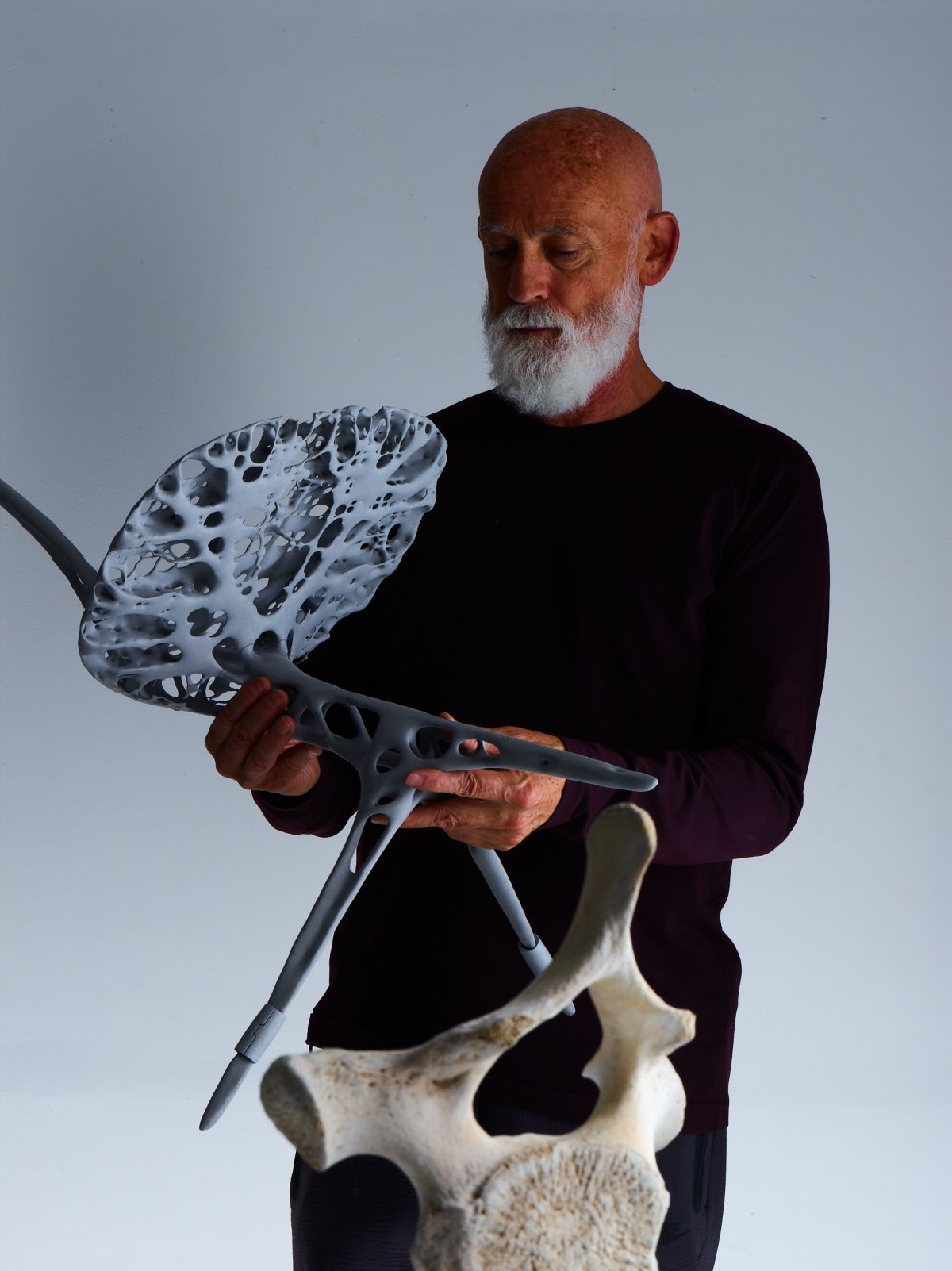
The chair project with DeepMind translated your biomorphic language into a prototype that could be 3D printed. Do you see AI as primarily a conceptual partner, or do you believe it will soon become a true production tool capable of reshaping how industrial objects are conceived, engineered, and manufactured?
The resulting chair, in my view, was better than expected but had many practical faults. If I had been permitted to take it into the next phase, I would have significantly reduced its mass and adjusted its proportions as part of a “flip-flop” process in search of optimisation, while preserving its emotional qualities.
I believe the next step will be co-creation between sketch, voice, and emotional charge. Beyond that, if the results are to hold relevance, an AI sequencing another AI would still require foundational human input as its purpose.
This means that industrial objects made through new processes and coding will be shaped by purpose, resource efficiency, and energy use, but not necessarily imagination.
The DeepMind experiment reportedly produced more than 600 variants, from which you chose a single “seed” to develop physically. What criteria did you use to recognise the one that had the right balance of logic, beauty, and emotional resonance?
The criteria was the reflexive charge that creators like myself have in recognising how all the conditions align to fuse, in time and space, the art that was waiting to emerge.
It is a point of convergence of all things considered or pre-thought, appearing as one.
This does not mean it is automatically good enough. I say this because many online comments were defending my own skills, without AI, in creating objects with a particular level of beauty and logic.
The process of co-authoring with AI depends on the human eye to arrest the point of development, because AI at present is not sophisticated enough to understand why it is creating what it is.
You have spoken about “feeding the model with yourself” so that the outputs become more organic, fluid, and avatar-like. How do you think designers should protect authorship and creative integrity when machines can learn their visual vocabulary so effectively?
I would say: live and let live. Go with the flow of possibility. Authorship, or the origin of species, will be traceable and attributable, but primarily for creators who have already established a reputation or a recognisable path.
It will require us to generate new and ingenious ways of seeing, or to hybridise between craft and industrial methods, in order to break AI’s expectations. Although AlphaGo once made a move that dumbfounded its opponent, suggesting I may be wrong, perhaps now it’s a different story.
We should accept the peculiarity of whatever is born out of this ever-expanding intelligence, even if it radically transforms the man-made landscape. Perhaps we are the limitation… holding back progress in an age already marked by human mismanagement and constrained thinking.
You seem less interested in AI as a threat than as a way of extending the past, present, and future into one continuum. What do you think most designers misunderstand about the relationship between memory, precedent, and machine-generated novelty?
There is a great deal of nostalgia in design across all disciplines. When something is authentic to its own time, it can stand still and allow the future to flow past it. But copying out of safety is tragic.
I see retrograde thinking as a major limitation. Often an affliction of an older academic generation attempting to preserve the light of the past.
Younger generations, on the other hand, often know very little about the history of their subject. This may stem from a reliance on search-based methodologies rather than deep engagement with books or primary sources.
However, this can also “reboot” the system, allowing references to emerge from a broader spectrum rather than a single channel.
We are currently in a grey zone: designers have some knowledge of the past, but everything is moving so fast that rules are being broken in favour of emergent aesthetics… forward-thinking and liberated from the weight of analogue models. Even if current AI outputs appear superficial, they will ultimately enable new ways of building what we imagine.
Your practice has always moved between sculpture, product design, and architecture. Where do you think AI is most likely to be transformative in your world: in ideation, in optimisation, in manufacturing, or in discovering forms humans would not have imagined alone?
AI will be transformative across all sectors, beginning most visibly with automotive design, which demands diversity and constant reinvention to remain compelling.
We already see radical proposals for architecture circulating on social media that appear highly plausible. In industrial design, consumers are tired of repetitive, “me-too” products and emotionally neutral design.
AI is perfectly positioned to help align manufacturing with innovation, enabling advanced 3D physical outcomes. Nature, and its coding, is the key to unlocking a future world driven by unlimited imagination.
You have been very clear that superficiality in design is often legitimised by hype, fashion, and passive consumption. How do you avoid AI becoming another engine of superficiality, and what would a truly intelligent, ethically grounded AI aesthetic look like to you?
We cannot dictate outcomes; we can only release a counterforce driven by coding and rapid sequencing, drawing on all known resources.
AI should be used to invent materials and processes that align with a coherent vision. This form of design is inspired by the extraordinary natural world. It’s a strange species shaped through coded evolutionary purpose and adaptation over time.
What we are beginning to access may resemble a form of quantum-conscious inertia—something we now have a real opportunity to understand.
If you could ask your AI collaborator one question about the future of design, what would it be… and what answer would you secretly hope it gave you?
Is the human brain… its capacity, composition, and complexity, capable of assimilating the entire fabric and meaning of the universe?
Yes… Because once humans understand their purpose, they will sacrifice their past for their future.