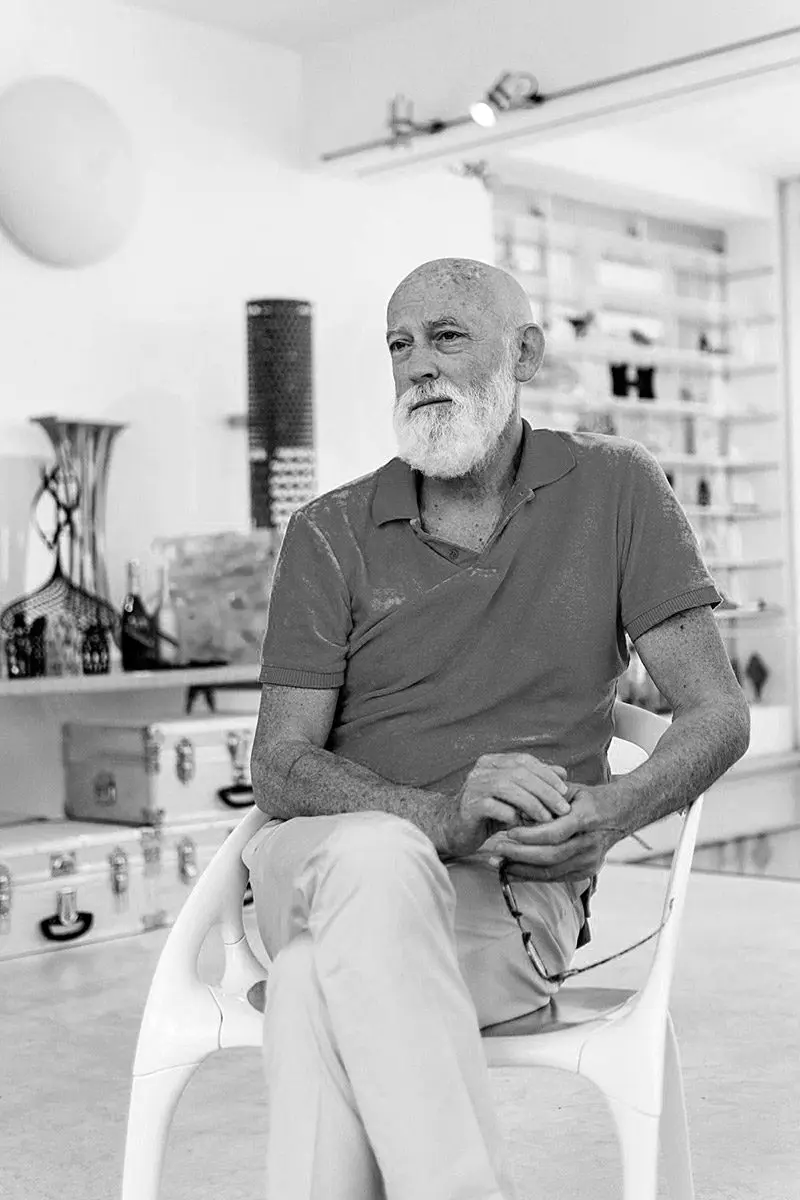
Lead Interview with Ross Lovegrove
Headline: Sculptor of Technology: Ross Lovegrove on DNA, AI and the Future of Form
Standfirst: In a world of greenwashing and surface-level styling, Ross Lovegrove, one of the world’s most acclaimed and influential designers, argues for bio-intelligent design where materials, algorithms, and emotion all answer to an inner code.
The first thing Ross Lovegrove tells me from his base in Dubai, is that he has always thought of himself less as a designer and more as a “sculptor of technology.” That phrase lands with particular force in 2026, when so much of what passes for design is, in his view, little more than cosmetic styling wrapped around addictive interfaces and disposable products.
For Lovegrove, form is never superficial: every curve, void and surface must answer to a deeper logic that fuses industrial rigour with a kind of biospheric poetry, so that objects feel as though they have grown rather than been manufactured.
His now-famous DNA philosophy—Design, Nature, Art—emerges in conversation not as a slogan but as a living system of thought. It suggests that a product, a building, even a brand, should have an inner genetic code, an unseen sequence that holds together its material honesty, emotional impact, and long-term relevance.
Lovegrove talks about studying materials until their inherent properties “prevail,” pushing algorithms and additive manufacturing to achieve what he calls a win–win–win: minimum energy, minimum material mass, maximum effect.
Whether he is speaking about rocket engines optimised by computational engineering, a 3D-printed chair born from an AI dialogue, or the lost organic DNA of a historic car marque, the same principle applies: integrity lies in the code, not the gloss.
What has changed around that code, he suggests, is the surrounding environment. The convergence of AI, accelerated digital culture, and a global appetite for the instant has made it easier than ever to hype the superficial and harder to locate true substance. Lovegrove is unsparing about greenwashing and nostalgic branding that sever its own genetic heritage, yet he remains energised by the possibilities of co-creating with intelligent systems—training models on decades of his drawings, selecting a single “seed” from hundreds of AI-generated variants, feeding his own design DNA back into itself.
As we speak, he oscillates between Basquiat and quantum computing, between museums that treat his work as sculpture and startups in Silicon Valley and Shenzhen that see in it a new aesthetic paradigm. The thread running through it all is clear: in a dematerialising, poly-sensorial future, what will endure are the codes—human, biological, computational—that carry genuine meaning.
Could you please encapsulate for our readers your DNA philosophy and reflect upon how it has evolved and how you currently feel about it?
I think that the superficiality in art and design will continue as in many ways it’s legitimised by a combination of instant attraction, consumer ignorance and passivity.
To be fair to consumers and collectors, things are changing rapidly in terms of taste and the value system, so it’s becoming easier to hype the importance of things.
Additionally, people just don’t know how things are made, so in the case of everything from cars to watches to smartphones, everything is judged by other perceptions, cool styling, incredible function, build quality, or mass cult adoption of the new.
It’s hard to define integrity anymore… I think of Basquiat versus Rembrandt or Rolls-Royce versus BYD; they just are so far apart generationally that it’s almost ridiculous to make comparisons.
In my case, after years of advocating a form of evolutionary approach to design, the convergence of AI, addictive technologies, and a search for more emotionally free forms that are not cynically derived but with sophisticated meaning and presence is now being understood. I’m being approached by multiple technology startups in Silicon Valley and Shenzhen that see my work as the new paradigm shift in aesthetics.
If a product, a building, or even a brand had an inner genetic code, and you were to sequence its DNA, what elements would you expect, or at least hope to find inside it?
Well, I consider myself a Sculptor of Technology, and with that, I have always appreciated the work of Designers who fuse Art with Design.
Design with a sculptural mindset stands out; it doesn’t cost more to make, but it certainly celebrates and respects the material resources it consumes. It takes longer to study and create as one is looking for properties that prevail and draw out a sense of rarity and uniqueness from the multiple industrialisation processes. Everything, and I mean everything, I design is thought through like this.
It’s because I want my work to be fascinating, otherworldly, new and viscerally captivating, visually and physically tactile, as I believe this is the true universal language of a biospheric species.
If we think of you more as an evolutionary biologist than a designer, working with what you call “organic essentialism.” In 2026, what does that mean in practice when many brands still default to surface-level styling rather than structural or substantial integrity?
DNA stands for Design, Nature, Art but it also implies a form of biological connection to the very essence of life. I actually met James Watson, the co-discoverer of DNA, and was impressed by how fluid the exchange was around the process of creativity and how we reveal the unseen, speculating from a position of pure instinct, knowing something could exist and then searching for it.
Design is like this and almost has a quantum dimension to its initiation.
You have created everything from chairs and lighting to transport concepts and architectural interventions; museums around the world hold your work as if it were sculpture. When does a designed object stop being “industrial design” and become, in your view, a piece of living sculpture?
Yes, absolutely. In my second TED Global talk entitled Lovegrove GENESIS in 2013 at Oxford, I proposed that we use algorithms to feed the model with all we know on a particular object and then give us the optimised contemporary version of what it should be, not could be.
One is a coding model that is driven by absolutes; the other is styling. In an age of issues about energy consumption, CO2 emissions, resource drawdowns and conflict zones etc., there is a legitimate need to rationalise mass-produced objects in every sense, but this is a win-win-win: minimum energy, minimum material mass, maximum effect… just like nature.
The work of my friends Lin Kayser and Josefine Lissner of LEAP 71 [pioneers in the new field of Computational Engineering] proves this, as they are some of the world’s greatest coders, designing advanced rocket engines, which are 3D printed. Their forms are proof of concept for me.
So, sequencing the DNA of brands past, present, and future, embracing what they represent philosophically, can I believe, become an incredible new business strategy because it simply cuts through arbitrary human creation, which has meandering goals or perceptions and an often superficial effect.
Brands today love to speak about sustainability, yet much of what they produce is still driven by short-term novelty. As someone nicknamed “Captain Organic,” how do you distinguish between genuine bio-intelligent design and greenwashed aesthetics—and what questions should brand leaders be asking themselves before they launch anything new?
Greenwashing is everywhere, so you have to ask the question: what are brands sustaining? I think it’s such a complex issue, especially when we now know that the use of fossil fuels is growing exponentially to fund AI and the future that’s rapidly unfolding. I’m afraid it’s a free-for-all and that no matter what we do, the forces of change are too great.
Alternative materials at present are not scalable and often have primitive applications, so it’s an illusion right now that we can grow our way out of the problem. AI will support innovations in energy for sure, and with that, evolve new materials and processes to support a natural countermeasure to the hard permanence of modern manufacturing.
Additive Manufacturing [3D printing] is a key part of this, and advances in the field are astonishing across biotech, aerospace, product design, automotive, architecture, and other critical human-centric activities.
In your explorations of AI, collaborating with the likes of Google DeepMind to translate your biomorphic language into new forms, what has surprised you most about seeing an AI “learn” your way of thinking—and where do you draw the line between co-creation and losing authorship?
This subject is so fascinating for me as a designer who has harnessed any new emergent technology I have encountered. I have no scepticism for new technologies, and the advent of AI was predictable for me. Embracing it is incredible as it’s akin to collaborating with thousands of oneself, so one’s philosophy, DNA, aesthetics etc. just amplify.
The great advantage is that I have a massive library of my own projects and research that can create unlimited variants and permutations across multiple typologies. If you feed the model with yourself, you get a concentration that’s often organic, fluid, and avatar-like. As if morphogenic, generative design is the source code of life itself.
The work of Zaha Hadid is a good example where the practice is not copying anyone except itself. Frank Gehry is the same. So, it’s like Pollock or Kapoor in Art, proving the high cultural and monetary value of the intense, singular, unique iconography of their work.
This positioning will grow in value, and when I myself prompt and converge my own work, I get such an emotional fix that it’s so nourishing and inspiring.
My collaboration with Google DeepMind was timely and of the highest importance for me. Knowing what’s unfolding in the way we can communicate creativity made this a very powerful moment in time, understanding how we defend pure human creative skills and imagination whilst remaining open and in dialogue with astonishing new software.
The objective was to create a chair without ever prompting the word chair. My drawings are very well known, as is my analogue conception process, drawing in special leather notebooks over many years. Feeding my drawings into the process, the AI returned drawings that mimicked mine but in extreme Gaudí-Geiger geometries with more emphasis on beauty than logic.
The exchange resulted in more than 600 variants, of which I selected one as a ‘Seed’. This was then modelled into a data set for printing without modification and 3D printed in Spain by Oxido Studio. The result was fascinating in that it was relatively close to a well-proportioned, comfortable chair.
But it started a chain reaction online from creatives who flatteringly said, “Why would you use AI to create a chair that undermines the genius of Ross Lovegrove with something clearly inferior to what Ross Lovegrove can create without AI?”
I think this reaction is profound, but quite soon, and with emergent Solar and Gen Z Generations resetting the way we interact digitally and non-academically, the past will soon fade in favour of the instant and the new. For me, it’s important to maintain the fusion of past, present, and future as it is one, and should not be disconnected.
What the old mindset thought was wonderful and enriching, permanent, and human, will be replaced by a very new other-worldliness that is more dematerialised and virtual.
Life experience will be cerebral and mind-driven, poly-sensorial and haptic. We can register most things visually, ingest them and appreciate, share then dispose… the unfolding future is not about ownership of anything, so even as a designer the concept of participating simply, conceptually, and globally, without hard copy, is truly fascinating for me.
The authorship will only remain if I keep feeding my own design’s genetic coding back into itself over and over and letting AI, AGI, and Quantum run free and co-create in its interaction with my creative process.
If you were given absolute freedom to redesign a global brand’s entire physical universe—from products to flagships to micro-interactions—purely through the lens of Design, Nature, Art, what would you do first that might terrify their marketing department but delight future generations?
This is such a great question. Look at what Jaguar just did, which was shockingly destructive. They thought it would be disruptive, but it was clearly insane and illogical.
They followed superficial fashion and a marketing spiel that was crass, and a lot of executives got fooled. Jaguar has extraordinary organic DNA, like no other car brand.
When their cars were first designed, there was fantastic diversity in the sector, driven by exceptional designers and Italian styling houses, proving the wonders of human scale and the analogue process. There was absolute integrity, refinement, and undeniable beauty. This sounds nostalgic but in fact it just an appreciation of core DNA, genetic coding, genesis, and a relationship between sculpture, material, form, and dynamic movement.
These qualities are eternally relevant, especially as the brands that copy don’t know why they copy or what they are copying.
The DNA of Jaguar and the evolution of the car’s body and its 3D relationship to space displacement and its presence in time is an incredible opportunity to go again and revert to EI, Emotional Intelligence, as the base code of its next chapter.
Emotional intelligence can be seen in animate and inanimate objects… it’s a pulling force on your heart based upon human creativity and the transformation of materials into astonishing things.
I would fire the marketing dept and replace it with a young, advanced AI prompting team. I would advance my Google DeepMind programme (that gave rise to Nano Banana) and work with them and Jaguar as a new collaborative model. That’s not terrifying; it’s strategic creative intelligence based on one person’s vision, like the Steve Jobs or Elon effect, but through the lens of bringing a fusion of beauty and logic to our biosphere.